How to play Tongits, step by step
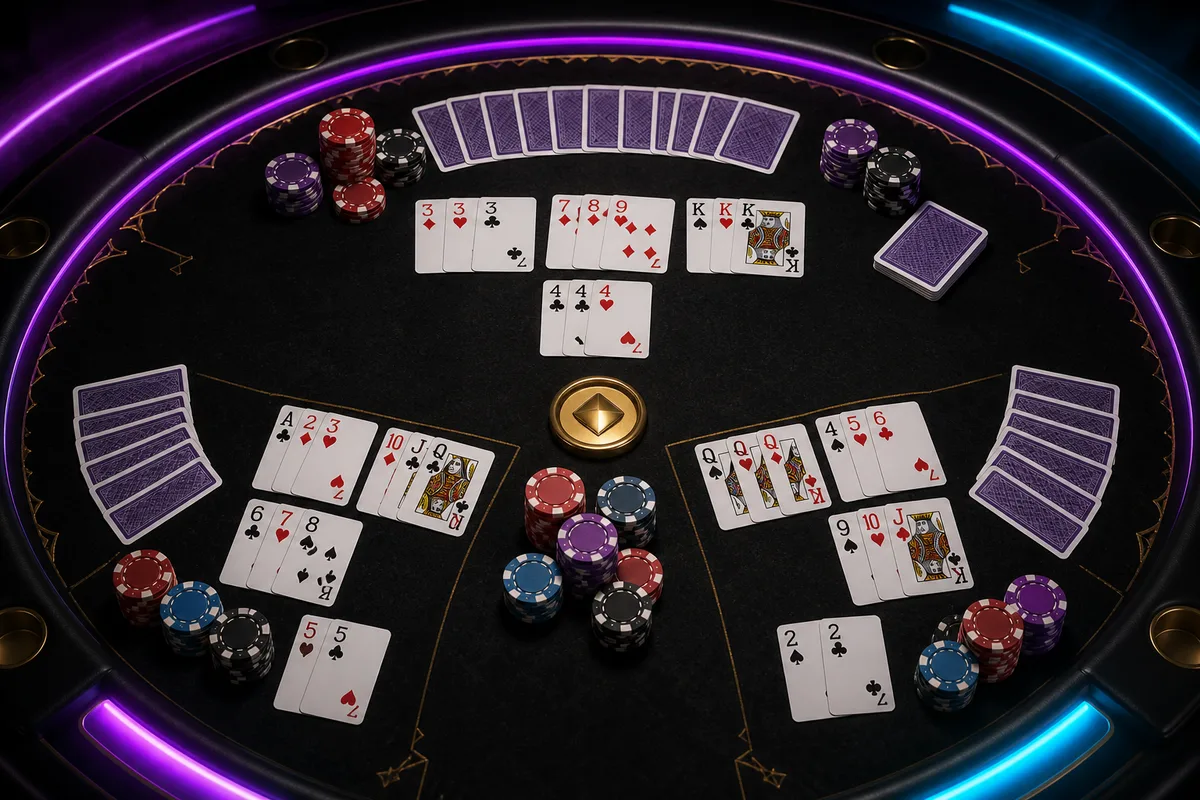
Tatlong players, isang deck. Deal 13 to the dealer and 12 to the others, then draw, meld or sapaw, and discard, until someone calls Tongits, wins a Fight, or the stock runs out.
Before the first deal
You need three players, one standard 52-card deck with the jokers removed, and chips or a score pad. Before anyone touches chips, agree four house rules out loud (or check them in the app’s rule panel):
- Ace: low only (A-2-3 is a run, Q-K-A is not) is the common default.
- Taking a discard: whether you must use it at once in a new exposed meld (most tables and apps say yes).
- Sapaw block: whether a sapaw on your meld stops you from calling Fight for a rotation.
- Sunog: what a burned player (no exposed meld) pays.
Set the unit size in pesos or chips while everyone is still calm. Online, confirm those four points in the in-app rule panel rather than trusting an old screenshot.
Shuffle, deal and starting hand sizes
- Shuffle thoroughly and let the player beside the dealer cut (how to shuffle and deal).
- Deal one card at a time: 13 to the dealer, 12 to each of the other two players.
- Put the rest face down in the centre as the stock (closed pile).
- The dealer may expose melds, then discards one card face up to start the discard pile. The dealer does not draw on this first turn.
Pagat describes the deal and play as counterclockwise; many home tables go clockwise. Agree the direction before the first hand. Many houses give the previous hand’s winner the next deal; write that rotation down too.
Count your cards once. A ready set or run in your starting hand is useful, but your first job is still to expose at least one legal meld before the hand ends, because a player with no exposed meld is sunog.
A legal turn, in order
- Draw: take the top card of the stock, or the top discard if you will use it immediately in a new exposed meld.
- Meld (optional): expose a set (three or four of the same rank) or a run (three or more consecutive cards in one suit).
- Sapaw (optional): add cards to any exposed meld on the table, yours or an opponent’s.
- Discard: end the turn by throwing exactly one card face up, unless you have just emptied your hand and called Tongits.
If a Fight (Draw) button appears, you can usually call it only at the start of your turn, only if you have an exposed meld, and only if nobody did sapaw on your melds since your last turn. Details: Tongits rules and when to call Fight.
App timers that discard for you are part of the rules. At a kitchen table, keep a polite pace so one player cannot stall forever.
Melds, sapaw and deadwood
Deadwood is every card in your hand that is not in a meld. Ace counts 1, 2–9 count face value, and 10, J, Q, K count 10 each. In a Fight or at stock-out, the lowest deadwood wins. Sapaw lowers your deadwood and can also block an opponent’s next call. Examples: melds and sapaw.
Three ways a hand ends
| Ending | What happens |
|---|---|
| Tongits | You empty your hand through melds, sapaw and a final card. Cleanest win on most sheets. |
| Fight / Draw | An open player calls; the others fold or challenge; the lowest deadwood among those in wins. |
| Stock-out | The stock runs out; open players compare deadwood and the lowest wins. Players with no exposed meld are sunog. |
A habit for your first sitting: if your unmelded face cards still add up to more than about 20 while the stock is thinning, focus on dumping and sapaw instead of chasing a perfect Tongits.
Checklist before you play for stakes
- Four house rules spoken or screenshotted.
- Unit size set; a peso limit and a time limit named out loud.
- First meld exposed before you chase a perfect hand.
- Sapaw used at least once to block a Fight, not only to dump cards.
- Score pad or app history checked once against Tongits scoring.
- Everyone at the table is 21+ if real money is involved.
Two practice drills
Drill A: deal three practice hands with no money and make every player say their deadwood out loud before each possible Fight. Drill B: play one hand where everyone must sapaw at least twice, even if the card “felt useful later”.
Most first-week losses come from rule mix-ups, not bad luck: mixing two house sheets, taking a discard without melding on a strict table, or calling Fight with high deadwood. Say the turn order out loud for three hands, then speed up. Next: Tongits strategy, common mistakes, and for home games a written ruleset.