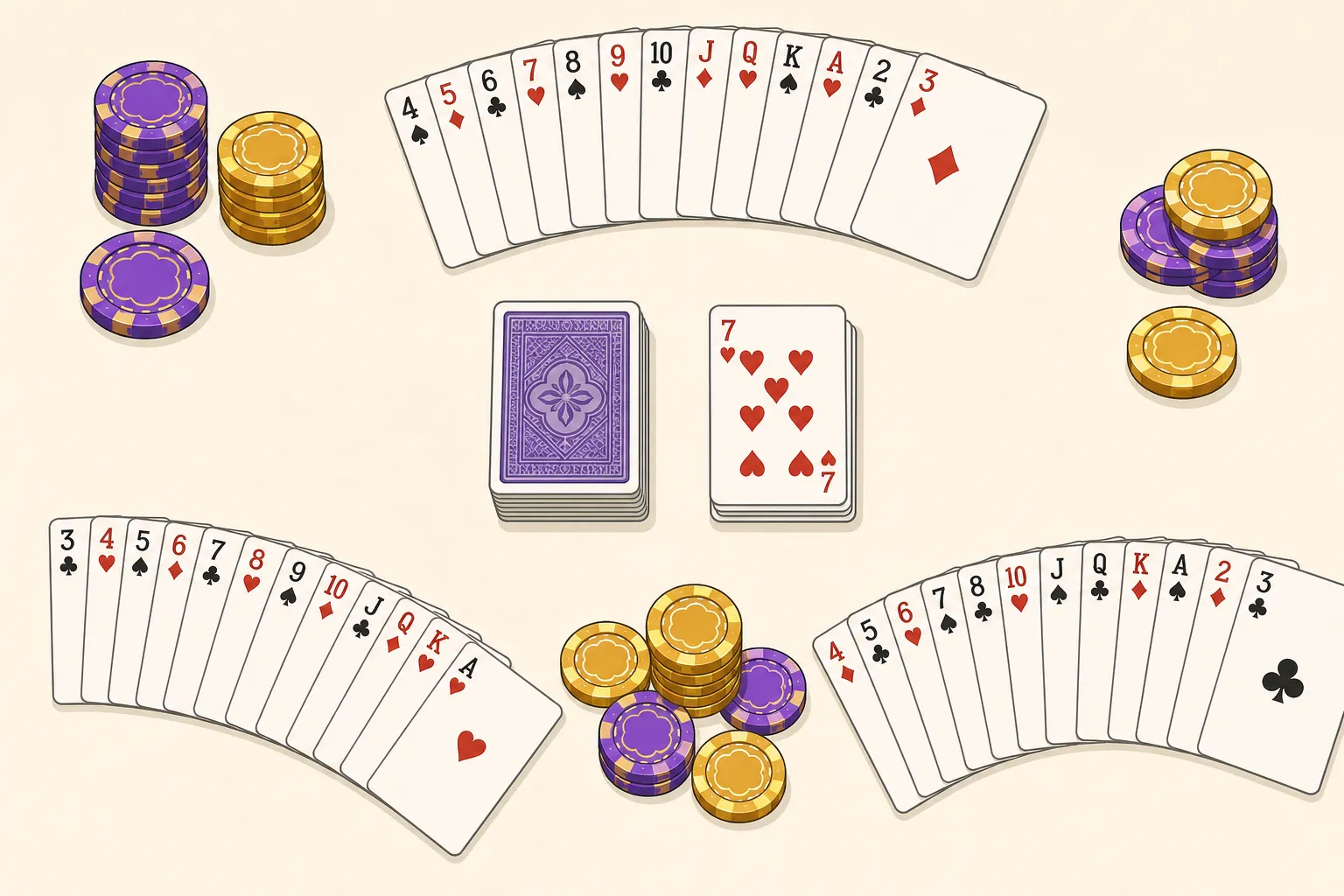
Tongits Fight: when to challenge, and when to keep dumping
Bilangin muna ang deadwood bago mag-Fight. Call only after you have opened, only when the call is legal, and only when your count is clearly low. Otherwise dump safe and wait.
Fight, Challenge and Draw: same moment, different names
Pagat uses “Draw” for the call that ends the hand and asks the other players to fold or challenge. Many PH tables say Fight or Challenge for that same call, or for an opponent’s decision to contest it, and some apps label the button Draw or Fight. Agree the words before the first deal so nobody pays three chips over vocabulary. Full rules: Tongits rules.
The caller does not win automatically. When a Fight is contested, the lowest unmelded (deadwood) total among eligible players wins.
When you are allowed to call
Most houses and apps share these locks. If the Fight button is grey, one of them applies:
- You must have opened (exposed at least one meld).
- You call at the start of your turn, before you draw.
- If an opponent did sapaw on your meld since your last turn, you cannot call this turn.
- If you laid off onto your own melds last turn, many houses make you wait another turn.
- A player with zero exposed melds (sunog) cannot win a contested Fight; they pay the burn.
Count your deadwood before you call
Ace is 1, 2–9 are face value, and 10, J, Q, K are 10 each. Add up every card not in a meld. Three face cards already put you at 30.
| Your deadwood (rough guide) | Table read | Lean |
|---|---|---|
| Teens / low 20s | At least one seat still closed or at sunog risk | Call more often |
| Mid 20s–30s | Both opponents opened, lots of sapaw traffic | Wait, or fold if someone else calls |
| 40+ | Stock still deep | Do not call; shed face cards first |
| Any | You were just sapaw’d | You cannot call; play the turn |
Strategy write-ups that simulate many hands tend to put a good call in the teens or low twenties while at least one opponent looks unopened. Use that as a rough guide, not a law. Calling with 40+ against two opened seats is hope, not maths.
Fight now or dump and wait?
Each turn you either call or keep playing and end with a dump (discard). Ask three questions:
| Cue | Lean Fight | Lean dump and wait |
|---|---|---|
| Your deadwood is very low | If you believe you are lower than both | If one opponent looks lighter |
| Fight is legal for you | Call when your count and your read agree | Dump if the call is blocked |
| An opponent just sapaw’d your meld | Usually blocked anyway | Dump safe deadwood, call next turn |
| Timer nearly out | Only if you already counted | Pre-pick a safe dump before auto-dump |
A worked example: your deadwood is clearly low after melds and sapaw, both opponents opened with face cards showing, and Fight is legal. Calling makes sense. Now change it: your count is middling, one opponent has not opened and has been quietly dumping low cards, and the timer is red. Dump the safest blank and stay ready next turn. That silent player may be lighter than you.
When someone else calls: fold or challenge
Fold unless you are clearly lower. On many house sheets a lost challenge pays a bigger schedule (often 3 chips instead of 1). Sapaw on the leader’s meld earlier in the round is the cheaper defence, because it can block their call before they reach it (sapaw rules and timing).
- Count your unmatched total before you speak.
- Note who has opened and who looks sunog.
- If you challenge, accept the house risk schedule.
- If you fold, fold cleanly; no “almost Fight” after cards are shown.
Agree ties and chips before the first deal
Published sources disagree on some ties (challenger wins vs caller wins). Lock the tie-break, the Fight/Draw/Challenge wording, and the chip amounts for a Tongits win, secret quads and a challenged Fight before you shuffle. In an app, the in-app rule sheet decides. More on table manners: multiplayer etiquette. Probability notes: Tongits probability.
Practise the call in free rooms first
Run the count-then-call routine in free-coin or no-stakes hands until it is automatic. Online timers (often around twenty seconds) punish hesitation, so decide before the button lights up. If you play for real money, you must be 21+; set a peso limit and a time limit first.